TREASURY OF CHESTNUTS
De boom
De kastanje als sociaal-object. De kastanje is een simpele vrucht die over een groot gebied voorkomt en gebruikt werd als basis-eten. Van Japan tot Noord-Amerika, het is een sterk en simpel symbool dat door mensen met uiteenlopende afkomst en uit verschillende lagen van de bevolking herkent wordt. Via de kastanje ontstaat er een plek om over traditie, cultuur, ecologie en verandering te praten.
Een sociaal-object is een object dat een menselijke verbinding tussen twee personen creëert.
Hundred Horse Chestnut
The Hundred-Horse Chestnut (Italian: Castagno dei Cento Cavalli; Sicilian: Castagnu dî Centu Cavaḍḍi) is the largest and oldest known sweet chestnut (Castanea sativa, family Fagaceae) in the world.[1][2]
text
Landscape and Change in Early Medieval Italy
Chapter 3 – The poetics of the chestnut in the early Middle Ages
Paolo Squatriti Cambridge University Press 2013
Cambridge World History of Food
chestnuts
… A second factor was the substitution of mulberry trees for chestnuts around the Rhone valley, where Lyon and its silk industry exerted considerable influence. Silkworms are fond of mulberry leaves, and the mulberry tree (unlike the chestnut) grows fast and produces quickly. Its cultivation, therefore, encouraged a cash economy as opposed to self-sufficiency…
But this was the time of the Physiocrats, who thought the soil was the only source of wealth and aimed at improving the productivity of farming by questioning all traditional rural economic processes. That chestnuts suffered at their hands is undisputable. In a query sent to provincial learned societies, François Quesnay and Victor Riqueti Mirabeau, both initiators of the Physiocratic school, asked the following questions: “Are there acorns or chestnuts used as foodstuff for pigs? Do chestnuts give a good income? Or are said chestnuts used as food for the peasants, inducing them to laziness?” (Quesnay 1888: 276). And in an agricultural text of a few decades later, the question of laziness was pursued: “To my knowledge, inhabitants of chestnut countries are nowhere friendly with work” (Bosc and Baudrillard 1821: 272). It went on to suggest that they refused to replace their trees with more productive plants because of their fear of taxation and concluded that they were not worthy citizens of the modern state.
The roman history of the chestnut culture
…The sweet chestnut and the walnut are cultivated trees. There is evidence that people were cultivating them as early as the first millennium BC. The study now shows what a decisive role the Roman colonial conquests played in the widespread spread of these two tree species in Central and Western Europe. This is particularly true for the chestnut, which experienced a real boom as a result of the Roman campaigns, especially on the southern slopes of the Alps and in France. The walnut was already widespread before that, which was consolidated by the Roman colonisation.
Ancient texts testify that the Romans, like the Greeks, cultivated the chestnut primarily because of its rapid growth and its durable wood. With the walnut tree, on the other hand, wood and food production were balanced from the beginning. With the planting of chestnut trees throughout Europe, the Roman Empire laid the foundation for the medieval chestnut culture. The sweet chestnut was used more and more as a food source and was at times also called the “bread of the poor”, especially in southern Switzerland. Today, both tree species are economically important in Europe for wood and fruit…
Chestnut articles Research + ideas:
- Possible articles:
1)The first ecological law & europe’s oldest living tree (wiki: Castagna de cento cavalli), and a sicilian chestnut recipe: “Renaissance Castagnaccio”
https://youtu.be/8jUg5TzMXhs?si=6iAMC2KfwyUt2R6T
2)How japanese people started loving Mont Blanc in the 1930s, and the japanese twist on an (maybe medieval) Alps favorite:
The history of Mont Blanc in Japan began in 1933 when Chimao Sakota, a Japanese pastry chef, was inspired by the dessert during a trip to Paris and Angelina, the renowned pastry shop. He introduced a unique Japanese version featuring a sponge cake base and yellow candied chestnut cream, which differed from the original meringue-based dessert. This “yellow Mont Blanc” became a signature item for Sakota’s Jiyugaoka pastry shop, also named “Mont Blanc,” and has since become a popular and cherished dessert in Japan.
Introduction and Adaptation
- Inspiration: In 1933, Chimao Sakota, a Japanese pastry chef, visited Paris and was introduced to the Mont Blanc dessert at the famous Angelina.
- Japanese Innovation: Sakota brought the concept back to Japan, but adapted it to suit local tastes.
- Yellow Chestnut Cream: He replaced the traditional meringue with spiraling vermicelli of yellow-colored Japanese chestnut cream (kuri kanroni).
- Sponge Cake Base: Instead of the original meringue base, Sakota used a soft and airy Castella sponge cake.
Popularization and Evolution
- The “Yellow Monburan”: This distinct Japanese version, characterized by its yellow hue, became the signature item of Sakota’s pastry shop in Tokyo’s Jiyugaoka district, named “Mont Blanc”.
- Widespread Appeal: The yellow Mont Blanc became a popular sweet and was enjoyed by many, especially during the baby boomer generation.
- Modern Interpretations: Over time, the term “Mont Blanc” in Japan has expanded to include various cream-topped pastries, and new flavors like matcha Mont Blanchave emerged, showcasing its continued evolution. https://tastecooking.com/japans-obsession-mont-blanc/#:~:text=There%20is%20a%20bakery%20that,in%20the%20autumn%20of%201945.
Recipe OG montblanc (simple – insert link here) + recipe OG KURI KANRONI (insert link here) / or Kurikinto = chestnut and sweetpotato https://www.justonecookbook.com/kuri-kinton-candied-chestnuts-with-sweet-potatoes/
3)The ghost trees: when giants roamed appalachia, and a native american chestnut and corn steamed bread in cornhusk recipe:
4)How Goa’s Portuguese colonial past (accidentally) inspired a vegan curry delight (Vegan Xacuti)
5)Aphrodite, Mozart, and ancient ex-voto offerings: recipe Capezzoli di Venere


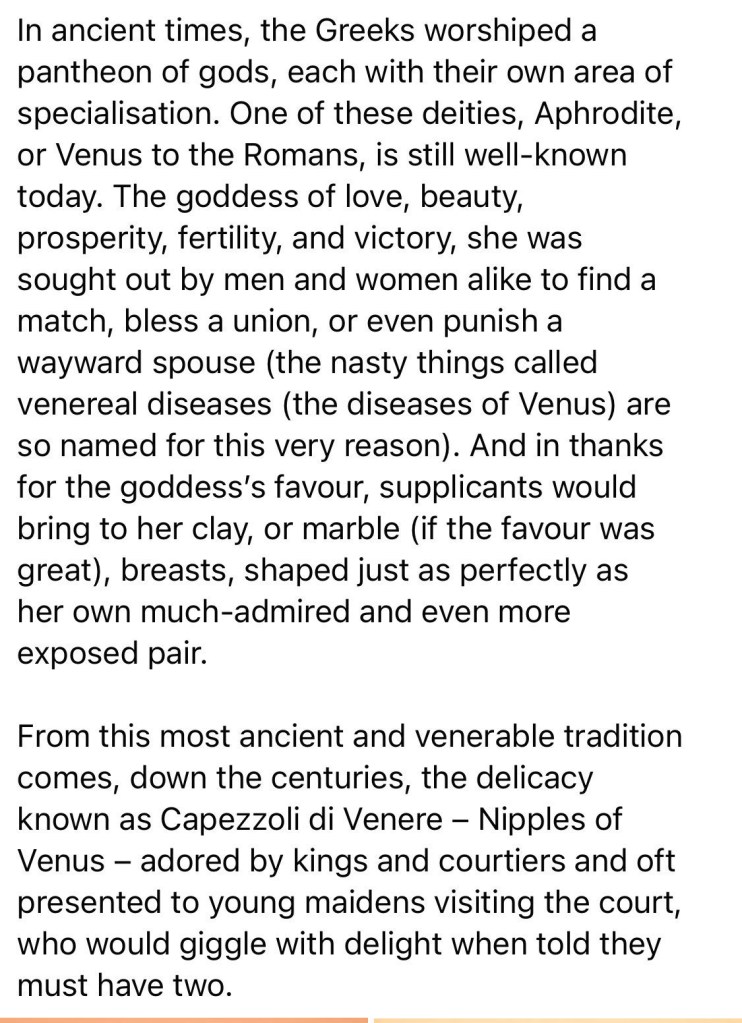
While the confection known as Capezzoli di Venere (Nipples of Venus) is a modern creation, the practice of offering molded body parts, such as breasts, to the goddess Venus dates back to ancient Greece and Rome. These offerings, often made of clay or marble, were a form of votive gift to thank the goddess of love and beauty for her blessings or to seek her favor. The name of the later dessert directly references this ancient custom, where the breasts symbolize the offerings made to the goddess.
Ancient Practice:
- Votive Offerings: In ancient times, supplicants would offer representations of body parts to deities, particularly the goddess of love and beauty, Aphrodite (Venus).
- Purpose: These offerings were made to express gratitude for favors received or to petition the goddess for blessings related to love, fertility, prosperity, and beauty.
- Materials: These representations of body parts were typically made from materials like clay or marble.
Connection to the Modern Dessert:
- Name: The name Capezzoli di Venere directly translates to “Nipples of Venus” and is a playful nod to the ancient practice of offering sculpted breasts to the goddess.
- Symbolism: The dessert’s shape, a chocolate truffle with a white chocolate “nipple” on top, serves as a modern, decadent interpretation of these ancient votive offerings.
- Historical Context: The dessert itself, a chestnut, brandy, and chocolate truffle, is a later creation, though it draws inspiration from the historical custom.
6) A not so holy Pope who loved chestnuts and debate in the church
B) Persoonlijke recepten:
- Ticino recept: pannekoeken van kastanje met geitenkaas en honing (Gambarogno – blijkbaar heten ze Necci!)
- Juliane’s Thanksgiving chestnut stew:cantherelle mushrooms, pear, cherries, chestnuts, thyme/sage onion garlic…cointreau/rum and garam masala or ethiopian spice mix with star anise and/or cardemom
- Trofie met salie en citroen?
- Italië in het algemeen https://en.julskitchen.com/first-course/fresh-pasta/chestnut-flour-fresh-pasta
- https://youtu.be/hkbJWrCHkTM?si=Dpy9-mf3j1g9ELv0
- https://youtu.be/I8FwM5R5iU8?si=1clvxg0mTMNkQNmq
 SPOON
SPOON 